

Updated April 2026 with current trends, construction comparisons, and curated picks from our 999-rug wool collection.
Of all the fibers woven into rugs over the past two thousand years, none has a more convincing track record than wool. This isn’t sentiment — it’s the thing you notice when you unroll a hundred-year-old hand-knotted rug and find the pile still springy, the dyes still true, and the structure still sound. No synthetic fiber made in the last century has matched that track record. Probably none made in the next century will either.
If you’re short on time, here’s the thirty-second version: buy wool if you want durability, natural stain resistance, and a rug that outlives your furniture. Hand-knotted wool is the benchmark for quality; hand-tufted is the best value; machine-made wool is entry-level but still better than polypropylene. Expect natural shedding in the first few months — it stops on its own. A well-cared-for wool rug lasts 20 to 50 years. That makes almost every other option look expensive in the long run.
2026 Wool Rug Trends
Wool has always sold on quality, but 2026 is the first year we’ve seen it sell heavily on environmental grounds too. The conversation around rugs is shifting.
The sustainable choice moment
Polypropylene and polyester rugs look cheap to buy and cheap to throw away — and that’s exactly what most buyers do every five to eight years. The environmental math is starting to bother people. Wool is a renewable fiber, fully biodegradable, and produces no microplastics when vacuumed. This year, we’re seeing more buyers explicitly citing sustainability when they choose wool. The fiber has always deserved that reputation; the mainstream is just catching up.
Warm natural undyed tones
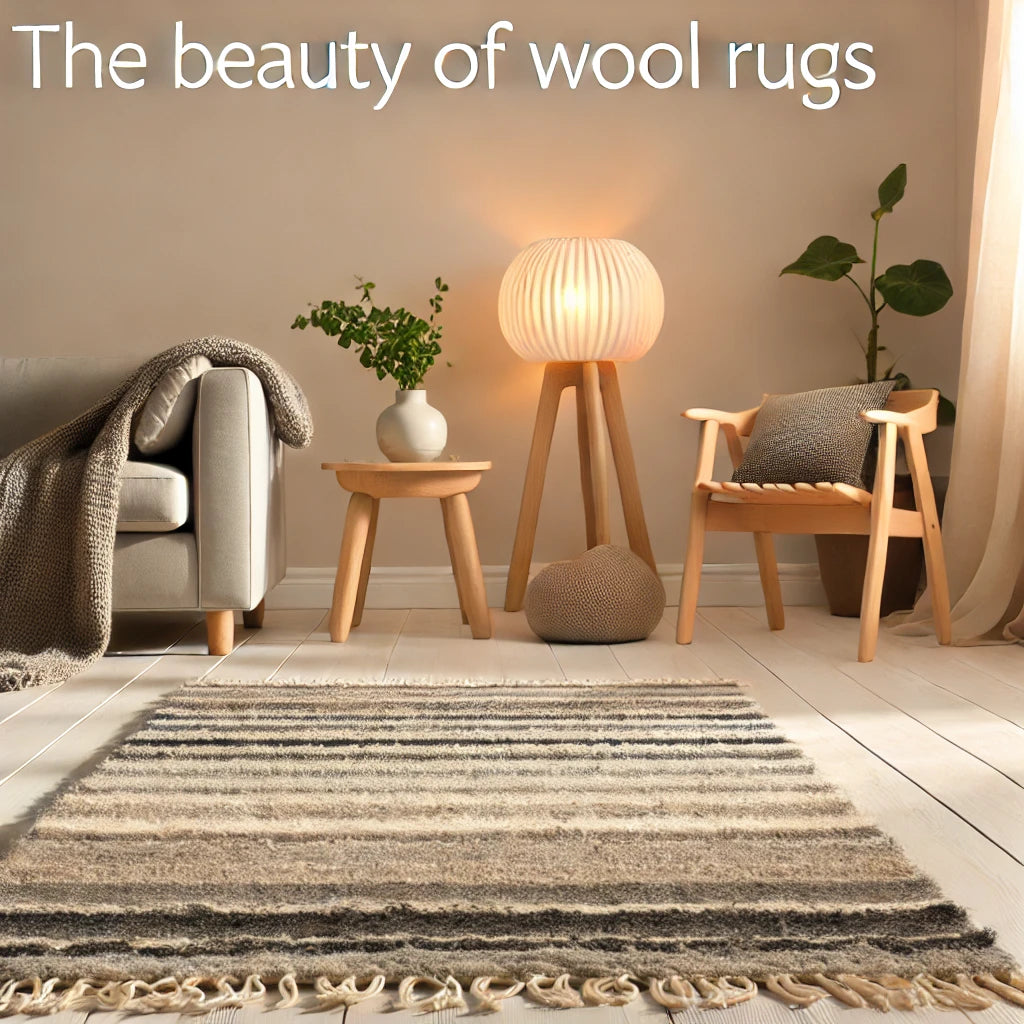
The gray era in interiors peaked around 2018 and has been retreating steadily. What’s replacing it isn’t beige in the old sense — it’s oat, camel, warm ivory, mushroom, and natural undyed fleece tones. Wool in its natural color palette is having a quiet moment. These rugs look simultaneously ancient and current, which is exactly what the 2026 interior aesthetic calls for.
Texture over pattern
Flat-woven wool, sculpted pile, and high-low textures are outselling elaborate medallion patterns among first-time wool buyers. The rug is being treated as a tactile element — something you feel underfoot rather than something you admire from a distance. Afghan flatweaves and Moroccan-influenced wool pieces are particularly strong this year.
Origin awareness
Buyers are asking where rugs are made more often than they were five years ago. “Hand-knotted in Afghanistan” or “hand-woven in India” is becoming a relevant piece of information rather than a throwaway detail. Regional traditions — Afghan tribal, Turkish Oushak, Persian classical — each have different construction and aesthetic DNA, and buyers increasingly want to understand what they’re purchasing.
Why Choose a Wool Rug?
Wool earns its premium with properties that no synthetic fiber fully replicates.
Durability that compounds over time
Wool fibers naturally crimp and coil at a microscopic level. This crimp acts like a spring — when the pile is compressed by foot traffic, it bounces back. Synthetics flatten under load and stay flat. A 10-year-old hand-knotted wool rug typically looks better than a 5-year-old polypropylene rug, because wool develops a patina while synthetic pile degrades. The 20-to-50-year lifespan figures attached to wool aren’t marketing — they’re based on actual surviving rugs.
Natural stain resistance
Raw wool contains lanolin, a waxy natural oil that creates a mild moisture-repellent barrier on the fiber surface. Liquid spills bead up rather than immediately penetrating. This doesn’t make wool stain-proof — red wine left overnight will still leave a mark — but it gives you a realistic window to blot and clean before the stain sets. No synthetic can match this property without chemical treatment.
Flame resistance
Wool is naturally flame-resistant. It doesn’t melt, drip, or sustain flame the way polypropylene and nylon do. In a house fire, a polypropylene rug contributes to the spread; a wool rug tends to char at the edge and self-extinguish. For families with young children, this is worth knowing.
Temperature and humidity regulation
Wool fiber absorbs and releases moisture. In a humid room, it absorbs moisture from the air, slightly reducing humidity. In a dry room, it releases that moisture back. This makes wool rugs feel warmer in winter and cooler in summer than synthetics — not dramatically, but measurably. It’s the same reason wool clothing outperforms synthetics across a wider temperature range.
Healthier than synthetics for allergy sufferers
Wool fibers have a microscopic scaly surface that traps dust mite allergens rather than releasing them into the air with movement. Multiple studies have found wool environments have lower airborne allergen concentrations than comparable synthetic environments. This doesn’t mean wool is medically proven hypoallergenic, but the mechanism is sound and the field evidence is consistent.
The Honest Trade-Offs
No material is perfect. Here is what wool costs you.
Price
A quality hand-knotted wool rug costs more upfront than the equivalent synthetic. Expect $400–$1,000 for a hand-tufted wool 8×10, and $1,500–$5,000+ for a hand-knotted wool 8×10 depending on origin and knot density. The counterargument: a synthetic rug in the same space might need replacing two or three times over the life of one wool rug. The cost per year often favors wool.
Initial shedding
New wool rugs shed. This is not a defect — it’s loose fibers from the manufacturing process working their way out of the pile. It looks alarming the first time you vacuum and the canister fills up with fuzz. It stops naturally after three to six months of regular vacuuming. Do not return a rug for shedding unless the shedding continues past six months at full intensity.
Moisture sensitivity
Wool and persistent moisture are a bad combination. Keep wool rugs out of bathrooms, laundry rooms, and basements unless ventilation is excellent and the space stays dry. Wool that stays damp develops mildew. A spill cleaned up within a reasonable time is fine; a rug that sits wet for days is a problem.
Weight
A full-size hand-knotted wool rug is heavy — sometimes 40 to 60 pounds for a 9×12. This is not a practical objection for most buyers, but plan accordingly if you’re moving furniture frequently or if you need to lift the rug for cleaning.
Wool Rug Construction Types
Not all wool rugs are made the same way. Construction is the most important variable after fiber quality.
Hand-knotted
The benchmark. A weaver ties individual knots around the warp threads by hand — sometimes thousands per square inch on fine pieces. A 9×12 hand-knotted rug can take 6 to 18 months to complete. The result is incredibly dense, fully reversible (both sides look finished), and essentially indestructible under normal use. If you’re buying one wool rug to keep for thirty years, buy hand-knotted. Our Afghan, Persian-inspired, and Turkish collection pieces are hand-knotted.
Hand-tufted
A tufting gun punches yarn loops through a canvas backing, which is then coated with latex and finished with a cloth backing. Faster to make, more affordable, and still genuinely comfortable and attractive. Hand-tufted wool is the best value category in our collection — you get natural fiber quality at a price point that works for most budgets. The trade-off is that the latex backing eventually breaks down; expect 15 to 25 years versus 30 to 50 for hand-knotted. Look for rugs with a cloth (not just latex) secondary backing for longer life.
Flatweave (kilim and dhurrie)
No pile — woven on a loom like fabric. Fully reversible, lightweight, and easier to clean than pile rugs. Flatweave wool handles foot traffic extremely well because there’s no pile to flatten. The trade-off is underfoot cushion; a good rug pad makes a significant difference under flatweave. Kilims are often wool, sometimes wool and cotton blended. Our kilim collection ranges from traditional geometric patterns to more contemporary flatweave designs.
Machine-made wool
A machine-loomed rug using real wool yarn. Less character and detail than handmade, lower knot density, and the back shows a uniform machine-woven pattern rather than the irregular hand-tied knots of a handmade piece. Still meaningfully better than polypropylene — the fiber is real, the durability is real, and the feel underfoot is genuinely good. Entry-level price point for customers who want natural fiber without the handmade premium.
Wool vs. Other Materials
Here is how wool compares against the fibers you’ll encounter at most price points.
| Material | Lifespan | Underfoot feel | Stain resistance | Relative cost |
|---|---|---|---|---|
| Wool (hand-knotted) | 30–50+ years | Excellent | Good (natural lanolin) | $$$$ |
| Wool (hand-tufted) | 15–25 years | Excellent | Good | $$–$$$ |
| Polypropylene | 5–10 years | Flat, plastic-like | Excellent (water-repellent) | $ |
| Viscose / bamboo silk | 3–8 years | Very soft, silky | Poor (absorbs liquid quickly) | $$–$$$ |
| Cotton flatweave | 5–15 years | Medium | Fair | $–$$ |
| Wool-nylon blend | 15–25 years | Good | Better than pure wool | $$–$$$ |
Wool vs. polypropylene: Polypropylene is fully water-resistant and nearly impossible to stain with most household liquids. It is also fully unable to age well, develops a plasticky sheen as it wears, and generates microplastic particles with every vacuum cycle. For a mudroom, laundry room, or outdoor area, polypropylene makes sense. For a living room or bedroom where you want something that improves with age, wool wins decisively.
Wool vs. viscose: Viscose (bamboo silk) is often sold as a premium upgrade. In feel, it is — viscose has an extraordinary softness and sheen that wool doesn’t match. In durability, it is not. Viscose fibers crush under traffic and are extremely sensitive to moisture. A viscose rug in a high-traffic living room will look tired within a few years. In a low-traffic formal sitting room or bedroom, it’s beautiful. For a living room you actually use, wool is the correct choice.
For a deeper look at fiber choices, our guide to choosing an eastern rug walks through material and style decisions in detail.
Room-by-Room Wool Rug Guide
Living room: the ideal application
Wool was made for living rooms. Daily foot traffic, the occasional dropped glass, years of sunlight — wool handles all of it better than any other fiber. The lanolin barrier gives you time to clean spills before they set; the fiber’s natural resilience means the pile bounces back from the weight of a sofa. An 8×10 or 9×12 hand-knotted wool rug under a living room seating arrangement is a 30-year purchase. See our 2026 living room rug guide for sizing and placement help.
Bedroom: exceptional
Bedrooms are low-traffic by definition, which means a bedroom wool rug will outlast a living-room wool rug by a significant margin. The reward is a soft, warm surface underfoot first thing in the morning. For bedrooms, a hand-tufted wool rug with a higher pile makes sense — you get luxury underfoot at a lower price than hand-knotted, and the lower traffic means the pile stays full much longer. See our bedroom rug guide for sizing by bed size.
Dining room: yes, with conditions
Wool works in dining rooms, but the maintenance picture changes. Food spills are different from living-room spills — they often involve proteins and fats that require faster cleanup. A flatweave wool kilim is actually our most practical dining room recommendation: no pile to trap debris, reversible, easier to spot-clean. If you want pile in the dining room, choose a hand-knotted wool with a shorter pile height and be prepared to vacuum more frequently.
Kitchen and bathroom: not recommended
The moisture risk is real. Kitchens and bathrooms retain humidity; wool absorbs it. In a well-ventilated kitchen where spills are immediately cleaned, a small wool runner could work — but we don’t sell wool into bathrooms and wouldn’t recommend it. A cotton bath mat or synthetic flatweave is the right call for moisture-prone spaces.
How to Choose the Right Wool Rug
Knot density and quality
Hand-knotted wool rugs are graded partly by KPSI — knots per square inch. More knots means finer detail, denser pile, longer production time, and higher cost. A tribal Afghan Oushak might have 25 to 50 KPSI; a fine Persian-style rug can exceed 200 KPSI. For most living rooms and bedrooms, 60 to 100 KPSI is the sweet spot: enough detail for complex designs, dense enough to last decades, without the fine-art-level price of ultra-high KPSI pieces.
Origin and tradition
Different regions have different wool qualities and construction traditions. Afghan wool is often considered among the world’s finest — high lanolin content, naturally soft, resistant to breakage. Indian wool tends to be used in hand-tufted and machine-made production, delivering consistent quality at lower price points. Turkish rugs traditionally use a double-knotted (Ghiordes) technique that produces an exceptionally tight pile. Iranian/Persian pieces are the most closely associated with high-KPSI fine rug making.
Pile height
Shorter pile (under 0.5 inches) wears more evenly, shows less crushing, and is easier to vacuum. It’s the right choice for high-traffic areas. Longer pile (0.75 to 1.5 inches) is more plush underfoot but will show furniture impressions and traffic lanes more readily. For living rooms: shorter pile. For bedrooms: longer pile if you want the luxurious feel.
New vs. antique
Antique wool rugs have one advantage over new ones: they’ve already done their shedding and their colors have fully settled. A 40-year-old hand-knotted wool rug is typically more stable than a new one in terms of immediate maintenance. The trade-off is that antique pieces require more vetting — check for moth damage, foundation integrity, and previous repairs. Our guide to oriental rugs covers the origin and age questions in more depth.
Caring for Your Wool Rug
The longevity of a wool rug is not automatic — it requires a few consistent habits.
- Vacuum weekly, without a beater bar. On hand-knotted or hand-tufted wool rugs, the beater bar can pull fibers loose and accelerate fraying at the edges. Use suction-only mode. For flatweave wool rugs, you can vacuum both sides.
- Rotate every six months. Uneven sun exposure and traffic patterns will fade and wear one section of the rug faster than another. Rotating redistributes both. Set a calendar reminder — this is easy to forget and the damage is slow and cumulative.
- Blot spills immediately, never rub. Work from the outside of the spill inward with a clean white cloth. Rubbing pushes the liquid deeper into the pile and spreads it outward. For protein-based stains (food, blood), cold water first. For tannin stains (coffee, tea, wine), a tiny amount of dish soap in cold water.
- Use a quality rug pad. A rug pad extends pile life by reducing the friction between the rug backing and the floor. It also prevents slipping, which is a practical safety issue. For hardwood floors, use a non-slip natural rubber pad — not the cheap foam type that can off-gas and discolor your floor.
- Professional cleaning every 2–3 years. Find a specialist who hand-washes rugs — not a carpet-cleaning company that steam-cleans everything with the same machine. Professional rug washing involves submersion, gentle brushing, and controlled drying. It’s a different service.
- Expect shedding in the first few months. Vacuum regularly, it stops naturally. Do not pick at the pile, do not shave it, and do not panic about it.
Frequently Asked Questions
Are wool rugs worth the higher price?
Over a 20-year horizon, almost always yes. A $1,200 hand-tufted wool rug that lasts 20 years costs $60 per year. A $300 polypropylene rug replaced every 6 years costs $50 per year — and produces three discarded rugs. The wool option is genuinely competitive on cost per year, and it’s not even close on quality or environmental impact.
Do all wool rugs shed?
New wool rugs shed loose fibers during the first few months. This is normal and temporary. The amount of shedding depends on how the rug was made — hand-tufted rugs tend to shed more initially than hand-knotted ones. Regular vacuuming on the highest setting (suction only, no beater bar) accelerates the process. Shedding that continues at full intensity past six months is worth discussing with the retailer.
Can I clean a wool rug myself?
Minor spills: yes, with the blot-don’t-rub technique and cold water. Deeper cleaning or set stains: no — DIY shampooing, steam cleaning, or soaking can cause wool to shrink, bleed dyes, or delaminate the backing. A professional hand-wash every 2 to 3 years is the right approach for deep cleaning.
What is the difference between a pure wool rug and a wool-blend rug?
Pure wool rugs use 100% wool pile. Wool-blend rugs mix wool with nylon, polypropylene, or other synthetics. Blends are sometimes marketed on improved stain resistance — nylon adds synthetic stain-resistance to wool’s natural properties. The trade-off is some loss of the natural feel and the sustainability credentials. For most residential applications, pure wool is worth the small premium over blends.
How long does a wool rug actually last?
Hand-knotted wool: 30 to 50+ years with routine care. There are hand-knotted wool rugs still in active use that were made in the early twentieth century. Hand-tufted wool: 15 to 25 years, limited partly by the latex backing. Machine-made wool: 10 to 20 years depending on traffic and care. Compare this with polypropylene at 5 to 10 years and viscose at 3 to 8 years.
Are wool rugs good for people with allergies?
Wool is generally considered better than synthetic fibers for allergy-sensitive households. The fiber’s microscopic scales trap allergens (dust mite debris, pollen) in the pile rather than releasing them into the air when the rug is walked on. This is the opposite behavior from smooth synthetic fibers, which tend to release trapped particles under foot traffic. Wool also doesn’t off-gas VOCs the way some synthetic backing materials can.
Recommended Wool Rugs from Our Collection
We carry over 700 wool rugs in stock at our Deer Park, NY warehouse — hand-knotted, hand-tufted, flatweave, and machine-made — across every size, color, and style. A few ways to browse:
Browse by construction: Hand-knotted rugs · Hand-tufted rugs · All wool rugs
Browse by size: 8×10 rugs · 9×12 rugs · 5×8 rugs · Runner rugs
Browse by color: Beige and ivory rugs · Blue · Red and burgundy · Gray
Every rug we sell ships free on orders over $99 and comes with a thirty-day return policy. If you’re deciding between two pieces or need a second opinion on size, send us a photo at info@eorc.us — we’ve been doing this for over thirty years and we’re happy to help.
Wool is the traditional fiber for authentic Persian rugs. Our Persian rug guide covers how construction type and fiber quality interact, and what to look for when buying a hand-knotted wool rug.
To understand how wool quality and construction interact across different weaving traditions, our oriental rug guide covers the major rug-producing regions and what makes each distinctive.
Eastern Oriental Rugs is a wholesale and retail rug company based in Deer Park, NY, supplying area rugs to homeowners, interior designers, and major retailers across North America since the 1980s.

